It is important that Obesity surgery patients adopt an exercise routine after undergoing the procedure. Bariatric surgery is effective in helping patients
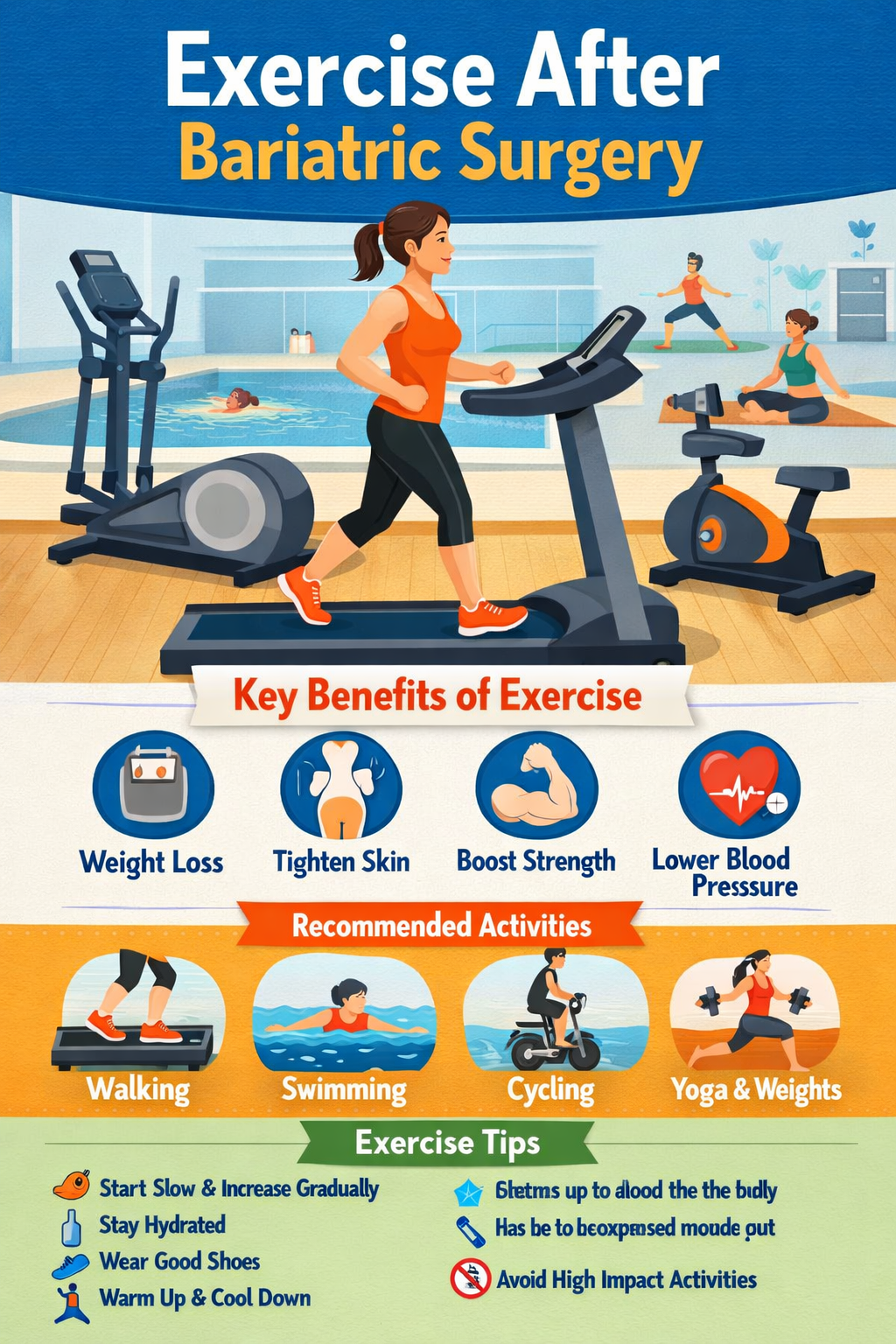
It is important that Obesity surgery patients adopt an exercise routine after undergoing the procedure. Bariatric surgery is effective in helping patients lose weight in a year after the procedure is performed, it is not enough to help maintain a healthy weight. In addition to following a proper diet after obesity surgery an exercise program is recommended to tighten skin, improve muscle tone, lower blood pressure and boost strength. The benefits of exercise following surgery are manifolds. Maintaining a fitness program after bariatric surgery puts you on the road to a healthy weight.
Frequently asked Questions.
1. What’s so important about exercise?
When you have a Bariatric surgery procedure, you lose weight because the amount of food energy (calories) you are able to eat is much less than your body needs to operate. The body has to make up the difference by burning reserves or unused tissues. Your body will tend to burn any unused muscle before it begins to burn the fat it has saved up. If you do not exercise daily, your body will break down your unused muscle and you will lose muscle mass and strength. Daily aerobic exercise for 20 minutes will burn the fat instead.
2. What is the right amount of exercise after weight loss surgery?
Many patients are hesitant about exercising after surgery, but exercise is an essential component of success after surgery. Exercise actually begins on the afternoon of surgery – the patient is encouraged to get out of bed and walking. Patients are encouraged to do deep breathing exercises and practice incentive spirometery from the next day of the surgery to improve chest compliance. The goal is to walk further on the next day, and progressively further every day after that, including the first few weeks at home. Patients when released from medical restrictions are encouraged to begin exercising about two weeks after surgery.
The type of exercise is dictated by the patient’s overall condition. Some patients who have severe knee problems can’t walk well, but may be able to swim or bicycle. Many patients begin with low stress forms of exercise and are encouraged to progress to more vigorous activity when they are able. The general thumb rule for any weight loss is 40-60 minutes per session at a low to moderate intensity for 5-7 times per week. The first 6 months post Bariatric surgery is the most critical period where one can lose about 60-70% of the extra weight. This can be achieved by a good exercise program.
3. How much Walking is allowed after the surgery?
Walk, Walk, Walk during the initial recovery period. Walk several times a day even if you can last for two–three minutes. For days two to seven following surgery walk for three to five minutes at a time, four to six times a day. The second week following surgery walk 5 to 15 minute 5 times a day. Gradually for weight loss the walk can be increased to 45-60 minutes a day. Start with normal pace walking and gradually increase to moderate intensity. Brisk walking is not recommended for obese people in order to avoid any detrimental stresses to the joints.
4. What kind of exercises is recommended after surgery?
The best exercise for bariatric surgery patients achieves a balance of three
a. Cardiovascular exercises
Improves cardiovascular endurance, burns calories and should be done 5-7 days in a week for 45-60 minutes per session. The exercise program should be based on low intensity aerobic activity where the duration is progressively increased. Duration and frequency are more important than intensity. Any Cardiovascular activities that places minimal stresses on the joint and produce minimal muscle fatigue are best. Good choices include walking, swimming and water exercises, dancing as well as stationary bicycling. Patients can also join GYM for cardio workout under medical supervision. Cardiovascular exercise should be the vital component of your exercise schedule.
b. Flexibility Exercise
should be done prior and later to all general exercises. These exercises elongates muscles, increases blood flow to muscles resulting in less soreness and more energy and improve chronic problems such as low back pain. 8-10 repetitions with hold period of 5-10 seconds are recommended. To get started we recommend a beginner’s Yoga class.
c. Weight training
In addition to aerobic activity, weight training should be done. Weight training or resistance training not only strengthens the muscle and bones but also raises the metabolism by increasing the muscle to fat ratio. As a result more calories are burned at rest. Begin with one set of 12-15 repetitions per exercise and progress to two sets per exercise thrice in a week using enough resistance so that It’s a slight struggle to complete the last couple of repetitions. Strengthening exercises can also be started in GYM with light machines. In addition to weight machines and dumbbells, rubber tubing or elastic bands to provide the resistance can be used.
5. When can I start doing sit ups or abdominal exercises?
Abdominal exercises can be started after about 3 weeks post surgery. Toning currents can also be given for abdominal muscles under the guidance of Physiotherapist to facilitate abdominal muscle work out.
6. When can I start to swim or exercise in the water?
Swimming or water exercise can be started after 3 weeks after taking clearance from your surgeon regarding wound healing.
7. Will exercise help with excess hanging skin?
Exercises after the surgery helps to increase the fat metabolism. This helps to tone up the muscle to avoid skin sagging and encourage weight loss.
8. Treadmill, cycling and Cross Trainer – Which one is the best to reduce the weight?
Average calories burned jogging on a treadmill for one hour is 705 to 866, on Cross trainer is 773 calories and people are likely to burn about 550 calories per hour on stationary cycle.
The Cross Trainer allows your body to emulate a running motion without causing the strenuous impact on your joints. As its elliptical pedals are suspended off the ground they lack the “weight-bearing effect” that is seen when walking and running on the ground/treadmill.
Running and walking on treadmill can help to strengthen your bones and muscles because of its weight bearing effect. It offers more versatility in terms of speed, incline resistance and the motor of a treadmill forces you to work out of your comfort zone. Forceful running on treadmill can cause strenuous impact on the joints. Patients with knees and back problems should avoid walking incline on the treadmill to prevent more stresses on the joints.
Stationary cycle is a good non weight bearing exercise machine but can increase knee pains in people with patella-femoral arthritis. One should consult their physiotherapist before they get started. Consider incorporating all the machines into your regime to reap the most benefit. Varying exercises and machines will help to avoid monotony and activate different muscle groups versus doing the same exercise on a continual basis.
9. Swimming and Walking – Which is a better exercise option?
Swimming and walking both are very good cardiovascular option. Swimming is a very good option for people who are unable to walk because of painful knees. The weight of an individual gets shared in water because of the water buoyancy allowing them to exercise better. It is also a good workout for abdominal muscles and offers resistance for muscles by placing less impact on the joints. People with painful knees should avoid breast stroke while swimming.
Walking should be the first exercise for bariatric surgery patients and is a perfect first step towards a robust exercise routine. Weight-bearing exercises like walking helps to strengthen bones and muscles and is particularly important for older people in preventing osteoporosis.
10. What are the general precautions while doing exercises?
• Wear comfortable clothing and good shoes.
• Have plenty of fluids.
• All stretching exercises should be done slowly and in controlled manner.
• “Warm-up” to give your body the necessary time it needs to get used to activity.
• End up by “Cooling-down” with stretching exercises.
• Gradually increase the duration and intensity of exercise.
• Bariatric patients are advised to follow a low intensity aerobic activity program.
• The duration and frequency are more important than intensity.
• Jogging and running should be avoided because it may overstress the joints.
• After surgery if exercise is not done the body will tend to burn unused muscle before it begins to burn the fat because of low calorie consumption. This will cause low muscle tone leading to weakness and fatigue.
Book a Consultation
It’s easy and free!